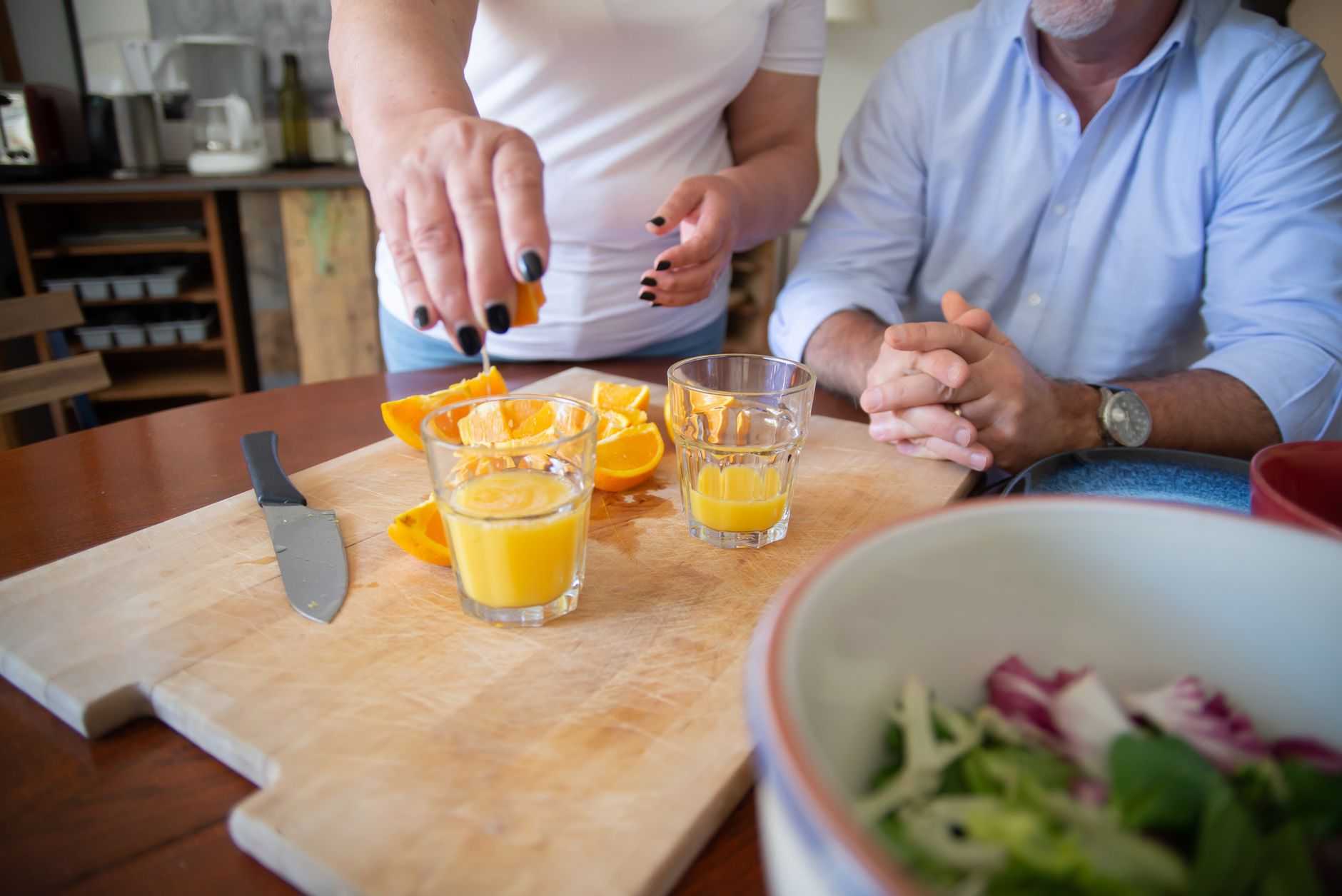
You reduce the physical cost of cooking with Parkinson's by moving the work to you, instead of moving yourself to the work. That means keeping everyday items within arm's reach on the counter, gathering all ingredients before you start, sitting or perching for prep, and sliding loads along the counter rather than carrying them across the room. None of this requires a renovation. Most of it is rearrangement, a stool, and a handful of inexpensive tools — changes that cut the three demands that make kitchens hazardous with Parkinson's: reaching, carrying, and prolonged standing.
Medical information disclaimer: This article is for general educational purposes only and does not provide medical advice, diagnosis, or treatment. Always consult a physician or other qualified health professional about symptoms, medications, tests, or treatment decisions.
Table of Contents
- Rearrange the kitchen so the reaching disappears
- Why carrying is the riskiest part of cooking
- Sit down for the parts that don't need standing
- Tools that remove the second hand from the job
- Shorten the meal itself
- Frequently Asked Questions
Rearrange the kitchen so the reaching disappears
The cheapest safety change is where things live. The Parkinson's Foundation's home safety guidance advises keeping the items you use most — plates, cups, everyday pots — out on the counter within easy reach, and moving frequently eaten refrigerator foods to the middle or top shelves. That single reorganization removes the deep bends and overhead stretches from routine cooking, both of which challenge balance. The same guidance makes one placement rule non-negotiable: store spices, pots, and pans near the stove so you never reach *over* a hot burner.
A tremor or a momentary loss of balance during an overhead reach becomes a burn when there is a live flame underneath the arm. Hardware matters too. The Foundation recommends swapping cabinet knobs for D-shaped handles, which you can open by hooking a finger rather than pinching. Rigidity and bradykinesia — the stiffness and slowness that define Parkinson's motor symptoms — erode pinch grip early, while a hooked pull keeps working far longer.
Why carrying is the riskiest part of cooking
Walking while carrying something is a dual task: your brain divides attention between the gait and the grip. Research by Monaghan and colleagues in the *Journal of Parkinson's Disease* found that people with Parkinson's show measurable dual-task interference, and that those with freezing of gait protect their walking speed at the expense of the manual task. Read that finding practically: the thing in your hands is what fails first.
The pot, the full glass, the tray of hot food is the part of the system that gets dropped while the legs keep going. That is the opposite of the intuition most people have, which is that they will stop walking if the load gets difficult. The design response is to stop carrying loads across open floor:.
- Slide pots and bowls along the counter instead of lifting and walking them.
- Use a wheeled cart or a rolling trolley to move food from kitchen to table.
- Move hot liquids in small volumes, or drain pasta with a strainer basket lifted out of the pot rather than carrying a full pot to the sink.
- Set the serving dish where it will be used before you fill it.
Sit down for the parts that don't need standing
Occupational therapists recommend chopping while seated at the kitchen table rather than standing at the counter, according to guidance compiled by Parkinson's News Today. Prep work — peeling, chopping, mixing, portioning — is often the longest phase of a meal and the one with the least need for a standing posture. Where sitting fully is impractical, a perching stool is the standard occupational therapy answer.
NHS West Suffolk's occupational therapy service describes it in its "Managing Your Energy" leaflet: height-adjustable, with a forward-tilted seat and armrests, so you take most of your weight off your legs while staying at counter height. The forward tilt is the point — it keeps your hips open and your reach to the work surface short. One limit worth naming: a perching stool needs stable footing and a surface it can be positioned squarely against. On a slippery floor, or at a counter with a deep toe-kick or an appliance underneath, a conventional chair at the table is the safer choice.
📨 Get Free Parkinson's Guides Alerts
Free · No spam · Unsubscribe anytime
Tools that remove the second hand from the job
Standard cutlery assumes two working hands: one stabilizes, one cuts. When one arm is already needed for balance or support, that assumption fails. The Parkinson's Foundation's mealtime guidance recommends adaptive cutting boards with raised sides and non-slip backing to hold food in place, and rocker knives that cut with a single hand — freeing the other arm to steady you.
Grip and tremor have inexpensive fixes. The same guidance notes you can build up utensil handles with tube-form pipe insulation from a hardware store, which widens a handle enough to be held with a loose fist instead of a fine pinch. Weighted utensils help damp tremor during both prep and eating; the added mass steadies small involuntary movements without requiring any change in technique.
Shorten the meal itself
The last standing time in a meal is not cooking — it is chopping beforehand and cleaning afterward. Both can be designed out. The Parkinson's Foundation and the Michael J.
Fox Foundation's rundown of kitchen assistive devices recommends buying pre-sliced ingredients and cooking one-pot meals, which cuts the fine-motor steps at the front and the washing-up at the back. A practical sequence that combines everything above: Pre-cut vegetables cost more per pound than whole ones. Weighed against a shorter standing period and fewer knife tasks on a difficult day, that premium is often the cheapest adaptation in the kitchen.
- Gather every ingredient, pan, and utensil onto the counter before you turn on the stove — this is the single change that most reduces trips across the kitchen.
- Sit or perch to chop, using a board with raised edges.
- Cook in one pot where the recipe allows.
- Slide or wheel the finished food to the table rather than carrying it.
- Leave everyday dishes on the counter afterward rather than returning them to high or low storage.
Frequently Asked Questions
Should I cook at a particular time of day?
Many people find prep easier during an "on" period, when medication is working well. Plan the chopping and lifting for those windows and leave simmering or reheating for later.
Is a perching stool better than a regular kitchen chair?
They solve different problems. A perching stool keeps you at counter height with weight off your legs; a standard chair at the table is more stable and better for long chopping sessions.
Do I need an occupational therapist to set this up?
No, but an OT assessment is the fastest route to the right stool height and the right tools for your specific grip and balance. Ask your neurologist or Parkinson's nurse for a referral.
You Might Also Like
- Orthostatic Hypotension in Parkinson’s: Why Standing Up Makes You Faint
- Parkinson’s and Getting Out of Bed: How Occupational Therapy Can Address Daily Obstacles
- I Have Parkinson’s and Cannot Turn Over Easily in Bed