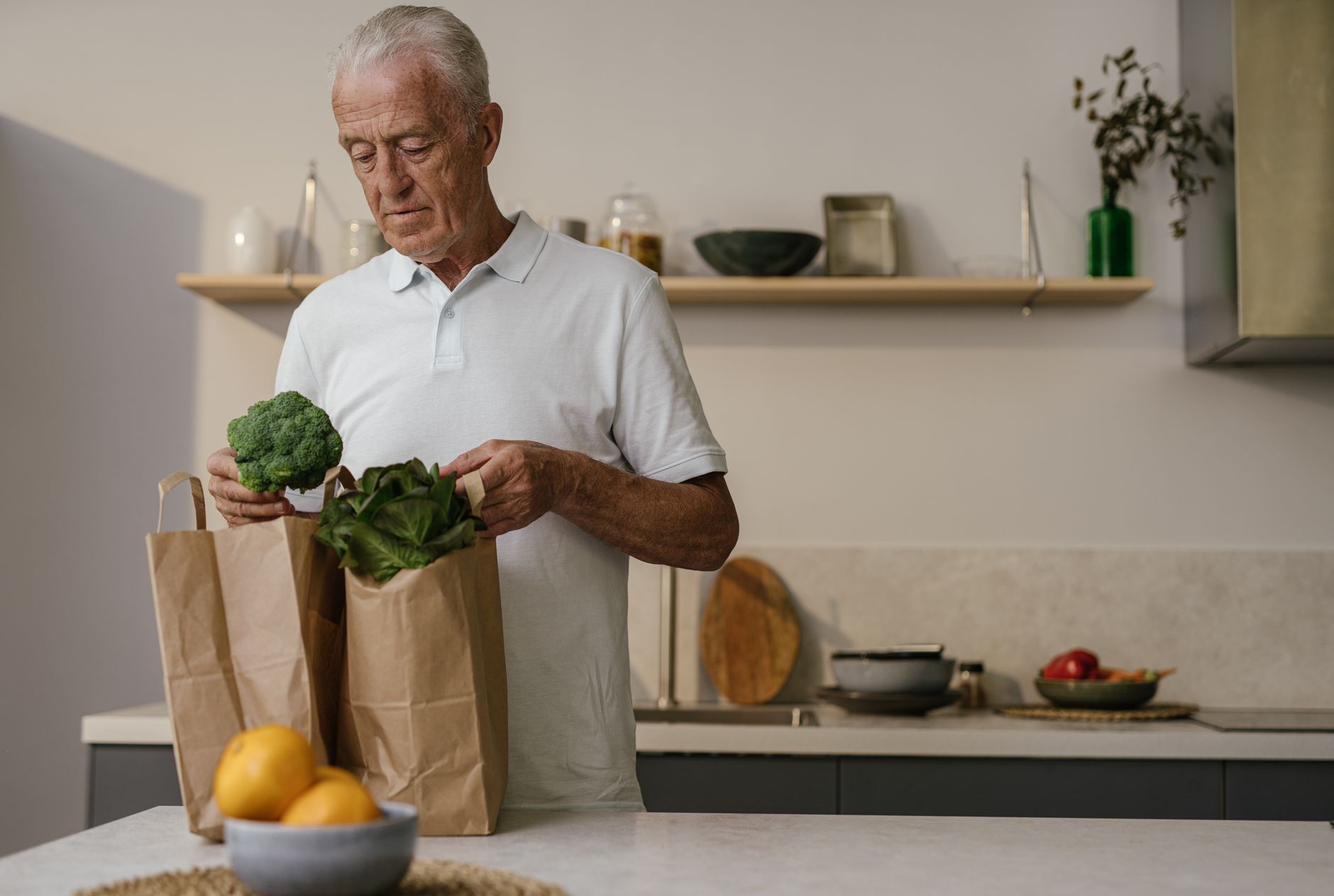
A Parkinson's diet checklist starts with four items: track when you eat protein relative to levodopa doses, ask your care team about a vitamin D test and a dietitian referral, verify every supplement for iron content, and monitor weight, fluids and fiber. There is no single prescribed Parkinson's diet — the Parkinson's Foundation recommends a varied diet of whole grains, vegetables, fruits and protein-rich foods, tailored with a doctor or dietitian. What makes diet worth tracking in Parkinson's is that food interacts directly with the main medication, with bone health, and with the disease's most common gut symptom. The checklist below turns those interactions into specific things to write down, questions to bring to appointments, and claims to verify before acting on them.
Medical information disclaimer: This article is for general educational purposes only and does not provide medical advice, diagnosis, or treatment. Always consult a physician or other qualified health professional about symptoms, medications, tests, or treatment decisions.
Table of Contents
- Track protein timing against your levodopa doses
- Verify your supplement list for iron
- Manage constipation with fluids and fiber you can count
- Ask about bone health — vitamin D, calcium, and weight
- What the MIND and Mediterranean diet evidence does — and does not — show
- The questions to bring to your next appointment
- Frequently Asked Questions
Track protein timing against your levodopa doses
Dietary protein competes with levodopa for the same intestinal absorption pathway. That means a chicken dinner eaten with a dose can blunt the dose, and a patient who logs "off" episodes without logging meals is missing half the picture. The Davis Phinney Foundation notes the common advice: take levodopa about 30 minutes before meals with a large glass of water, roughly 10 ounces.
For a week, keep a three-column log: If "off" episodes cluster after high-protein meals, that pattern is exactly what a neurologist or dietitian needs to see. Some patients with motor fluctuations are moved to a protein-redistribution diet — under 10 grams of protein during the day, with most of the day's roughly 70 grams shifted to the evening meal. The University of Florida's Fixel Institute cautions this is not one-size-fits-all: undereating protein risks muscle loss in older adults, so it belongs on the "ask" list, not the "try on your own" list.
- Time of each levodopa dose
- Time and rough protein content of each meal or snack
- Any "off" periods — when symptoms return before the next dose is due
Verify your supplement list for iron
Iron is the checklist item most likely to be hiding in plain sight. Iron supplements and iron-containing multivitamins bind levodopa in the gut, and studies in the Drugs.com interaction database show absorption cut by roughly half. The fix is separation: keep iron and levodopa doses at least 2 hours apart.
Pull out every bottle — prescription, over-the-counter, and "senior formula" multivitamins, which often include iron by default — and read the mineral line. Anything with iron either moves to a time slot 2 or more hours from every levodopa dose, or gets swapped for an iron-free formulation after a conversation with the prescriber. Bring the full list to the next appointment rather than editing it yourself; a supplement may be there for a documented deficiency.
Manage constipation with fluids and fiber you can count
Constipation is the most common non-motor gut symptom in Parkinson's, and it also slows the passage of medication to the intestine where levodopa is absorbed. The Parkinson's Foundation's constipation guidance is specific enough to track: 6–8 glasses of water daily, fiber-rich foods such as whole grains, brown rice, beans, prunes, kiwi and berries, and a warm liquid in the morning to stimulate a bowel movement. Countable daily targets: If the log shows targets met for two to three weeks with no improvement, that record turns a vague complaint into a documented one, and the conversation with the care team moves to next steps rather than starting from "drink more water.".
- 6–8 glasses of water, tallied, not estimated
- At least two fiber-rich foods from the list above
- One warm morning drink
- Bowel movement frequency, noted weekly
Ask about bone health — vitamin D, calcium, and weight
People with Parkinson's have about four times the hip-fracture risk of the general population, according to Parkinson's UK, driven partly by low vitamin D and by weight loss. That makes bone health a dietary issue, not just a falls issue, and it generates three checklist items.
Ask the doctor for a vitamin D blood level test rather than assuming supplementation is adequate. Track weight monthly on the same scale — unintended loss is both a fracture-risk driver and a signal worth flagging early. And verify that daily intake includes adequate calcium, paired with weight-bearing exercise, which the American Parkinson Disease Association identifies alongside diet as the practical levers on fracture risk.
📨 Get Free Parkinson's Guides Alerts
Free · No spam · Unsubscribe anytime
What the MIND and Mediterranean diet evidence does — and does not — show
Two lines of research make overall diet pattern worth a log entry. A 2021 University of British Columbia study of 167 people with Parkinson's and 119 controls, published in Movement Disorders, linked high adherence to the MIND diet — a Mediterranean-DASH hybrid emphasizing leafy greens, berries, whole grains and fish — to Parkinson's onset up to 17.4 years later in women, and Greek Mediterranean adherence to onset up to 8.4 years later in men. A separate cohort reported by Agarwal and colleagues found higher MIND scores associated with reduced incidence and slower progression of parkinsonism in old age.
The verification step is understanding what kind of evidence this is. Both studies are observational: they show people who ate this way fared better, not that the diet caused the difference. That is reason enough to lean toward the MIND pattern — it overlaps almost entirely with the Parkinson's Foundation's general advice and carries no known downside — but not reason to treat it as a therapy or to buy anything marketed on the back of these studies.
The questions to bring to your next appointment
The checklist ends as a script for the care team. A dietitian referral is the single highest-yield ask, since the Parkinson's Foundation's core recommendation is a diet tailored with a professional rather than a generic plan.
Bring the week of logs, the supplement bottles or a photo of their labels, and the weight record. A ten-minute appointment goes much further when the tracking has already been done.
- Should my levodopa timing change relative to meals, based on my protein log?
- Am I a candidate for a protein-redistribution diet, and who would supervise it?
- Can I get a vitamin D level checked, and is my calcium intake adequate?
- Which of my supplements contain iron, and how should I space them?
- My weight this month is X — is the trend a concern?
Frequently Asked Questions
Can I just stop eating protein to make levodopa work better?
No. Protein-redistribution diets shift protein to the evening rather than cutting it, and the University of Florida's Fixel Institute warns that undereating protein risks muscle loss in older adults. Any change should be supervised.
Does the MIND diet treat Parkinson's?
The studies linking it to later onset and slower progression are observational, so they show association, not cause. It is a sensible eating pattern, not a treatment.
Why does constipation matter for my medication?
Levodopa is absorbed in the intestine, so a sluggish gut can delay doses taking effect — managing constipation supports both comfort and medication response.
You Might Also Like
- How to Verify Diet and Nutrition for Parkinson’s Disease Claims in 2026: NIH, FDA, and trial records, Evidence, and Red Flags
- Diet and Nutrition for Parkinson’s Disease FAQ for August 2026: Source-Checked Answers to Common Questions
- Diet and Nutrition for Parkinson’s Disease Explained for 2026: Who It Affects, Key Evidence, and What to Do Next