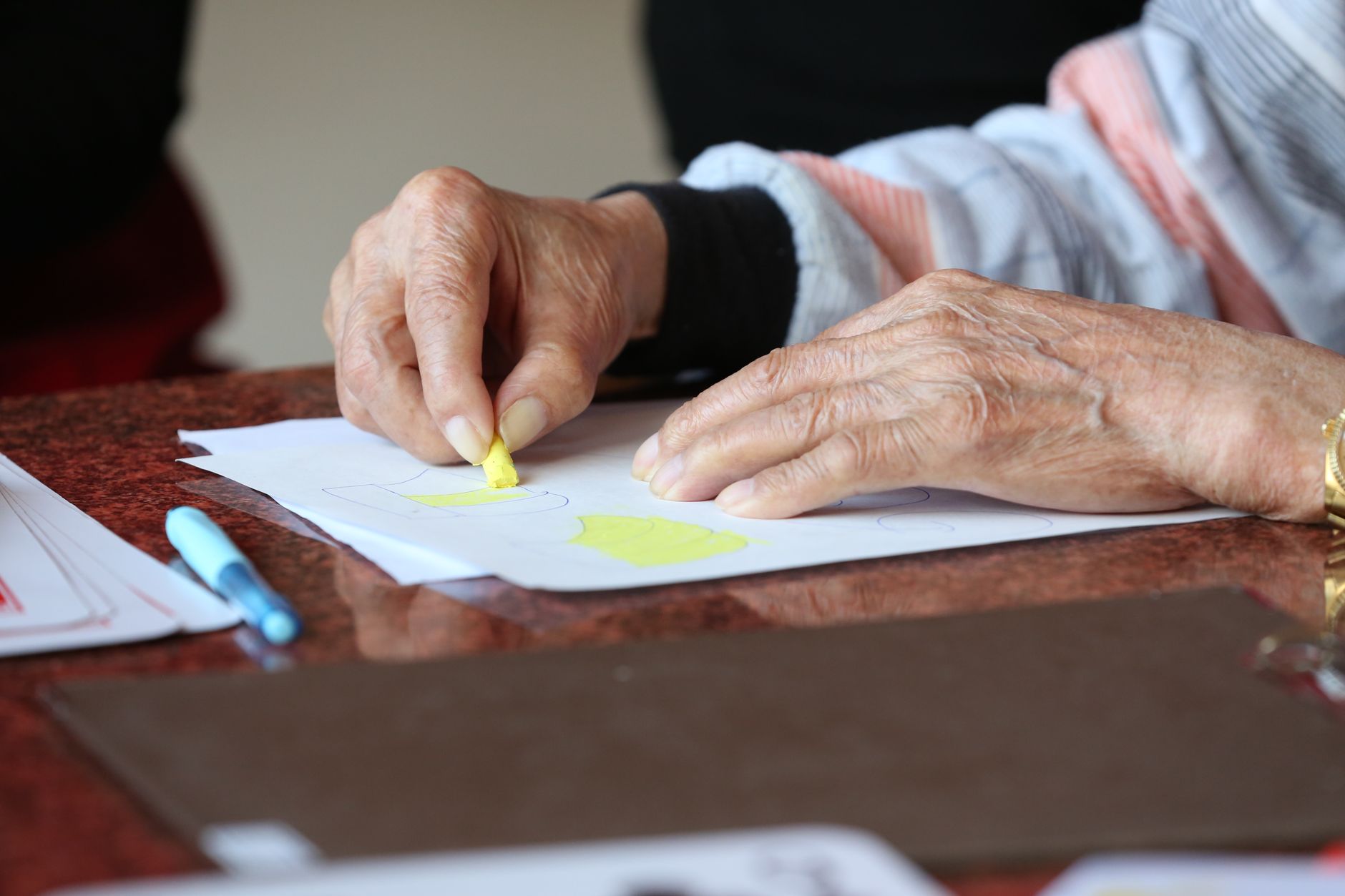
Art therapy offers Parkinson’s patients a pathway to rediscover meaning and purpose after retirement, when the loss of work structure and identity often hits hardest. Unlike talk therapy or traditional cognitive exercises, art therapy engages both the brain and body through creative expression, helping patients move beyond the limitations that Parkinson’s imposes. A patient might spend decades in a career, building identity around their professional role, and when that role ends—especially after a Parkinson’s diagnosis—the psychological weight can be as heavy as the motor symptoms.
When a retired accountant picks up a paintbrush for the first time in forty years, something shifts. The act of creating art bypasses some of the rigidity and tremor that Parkinson’s creates, allowing the person to communicate feelings that words or structured conversation cannot reach. Art therapy isn’t about producing gallery-worthy work; it’s about the process itself becoming a reason to get out of bed, to engage with the world, and to prove to oneself that life has shape and meaning beyond a disease diagnosis.
Table of Contents
- How Art Therapy Addresses the Emotional Crisis of Retirement With Parkinson’s
- The Creative Brain and Motor Symptom Management During Art-Making
- Rebuilding Identity Beyond the Disease Diagnosis
- Finding and Starting Art Therapy as a Parkinson’s Patient
- When Art Therapy Reaches Its Limits and What Else Is Needed
- Peer Connection and Community in Art Therapy Programs
- The Neurological Basis for Why Creative Expression Matters in Advanced Parkinson’s Disease
- Frequently Asked Questions
How Art Therapy Addresses the Emotional Crisis of Retirement With Parkinson’s
Retirement was meant to be freedom, but for many Parkinson’s patients, it becomes a collision of loss: loss of routine, loss of professional identity, loss of daily purpose, and now loss of physical capability. This compounding loss often triggers depression, anxiety, and a profound sense of being sidelined. Art therapy directly addresses this crisis by creating new structures and new identities within the creative realm. The beauty of art is that it demands presence but not perfection. A person with tremor can paint deliberately and expressively; the hand movements that frustrate them during eating become intentional brushstrokes on canvas.
A sculptor with rigidity finds that working with clay in small, focused movements actually feels more possible than many everyday tasks. Unlike returning to work or pursuing new hobbies that require extensive physical ability, art-making adapts to where the body is now. A participant in a Parkinson’s art program might discover that watercolor or collage feels more accessible than oil painting; that discovery itself becomes part of the journey, not a failure. Comparison matters here: someone taking a Parkinson’s medication class learns facts about their disease, which can increase anxiety. Someone in art therapy learns what they are still capable of creating, which can increase hope. Both have a role, but art therapy uniquely rebuilds agency and self-image rather than reinforcing the illness narrative.
The Creative Brain and Motor Symptom Management During Art-Making
The act of creating art engages neural pathways that Parkinson’s disease affects differently than it affects routine motor control. When focused on a creative task, some patients report that tremor seems less intrusive or that rigidity loosens slightly. This isn’t a cure; it’s a neurological phenomenon where concentrated attention and purposeful movement can temporarily shift how symptoms are experienced. The basal ganglia dysfunction that causes Parkinson’s affects automatic movements severely but can sometimes spare movement tied to intention and imagination. Art also provides a form of cognitive engagement that protects against the depression and cognitive decline that often accompany Parkinson’s. The problem-solving involved in composition, color mixing, perspective, or material choice exercises the brain in ways that passive activities do not.
A patient deciding whether a painting needs more warmth or coolness in a particular corner is engaging executive function, creativity, and decision-making—all cognitive domains that Parkinson’s can threaten over time. However, there is a real limitation: art therapy does not slow disease progression or improve motor function over time the way physical therapy or certain medications might. A person with advanced Parkinson’s who develops severe tremor may genuinely struggle to hold a brush or sculpt. Adaptive tools exist—weighted brushes, easels that stabilize canvas, modified grips—but they are not universal solutions. Art therapy works best when introduced early or when the person has the physical capacity to engage, and it may need to be reimagined as the disease progresses. Expecting art alone to manage motor symptoms is a misunderstanding that can lead to frustration.
Rebuilding Identity Beyond the Disease Diagnosis
Before Parkinson’s, a person had an identity shaped by work, family roles, hobbies, and accomplishments. The disease doesn’t erase those identities, but it pressures them: a teacher can no longer teach if tremor makes writing on the board impossible; a gardener cannot garden if balance is compromised; a golfer cannot golf if rigidity and bradykinesia steal the fluidity of the swing. Parkinson’s becomes a new, unwanted identity that can overshadow all others. Art therapy creates space for identity reconstruction. A retired engineer who spent forty years solving problems through logic and precision might discover visual thinking through painting—a completely different way of engaging her analytical mind. She is still thinking, still creating, still problem-solving, but through a new lens.
Over weeks and months, she stops introducing herself as “I have Parkinson’s” and starts saying “I’m taking an art class” or “I’m exploring mixed media.” The shift is subtle but profound. She is no longer primarily a person with a disease; she is an artist who happens to have Parkinson’s. This reframing is fragile and requires time. It typically doesn’t happen in a single session or even a month of classes. It requires consistency, a supportive environment, and permission to make “bad” art without judgment. Some art therapists who work with Parkinson’s patients deliberately avoid praise or critique, instead focusing on the experience of making. This contrasts with typical art instruction, where skill and output matter; in therapeutic art, the maker’s emotional and psychological engagement matters most.
Finding and Starting Art Therapy as a Parkinson’s Patient
Art therapy can be accessed through several pathways: some neurologists or movement disorder specialists refer patients to certified art therapists; some Parkinson’s organizations offer art classes; some community centers or hospitals run programs; and some patients find private art therapists who have experience with neurological conditions. The type of art matters less than the fit between patient and setting. A person who has always loved drawing might lean toward painting or printmaking; someone tactile might prefer sculpture, ceramics, or fiber arts. Someone intimidated by the blank page might start with collage, which uses pre-made materials and removes the pressure of drawing from scratch. The practical tradeoff is between structure and autonomy.
A formal art therapy program—often 6 to 12 weeks, one session per week—provides consistency, professional guidance, and peer support; it removes decision-making about “what to do” and creates accountability. But it also requires leaving home, potentially dealing with transportation challenges, and committing to a specific medium and schedule. A private art therapist offers customization and privacy but costs more money and requires self-direction in transportation and scheduling. Casual art at home—taking up painting in the garage—requires no financial outlay and no commute, but it lacks professional guidance and peer connection. Many patients find that starting in a structured class and then continuing at home strikes the right balance.
When Art Therapy Reaches Its Limits and What Else Is Needed
Art therapy is not a substitute for medical management of Parkinson’s. Someone whose tremor has become severe, whose cognition has declined, or whose depression is profound may need medication adjustment, physical therapy, occupational therapy, or psychiatric care before or alongside art therapy. A warning: if a Parkinson’s patient is offered art therapy as a primary treatment for motor symptoms or as a reason to delay or avoid medical care, that is a red flag. Art therapy is a complement to medical and rehabilitative care, not a replacement. Additionally, not every person will find art therapy healing or even tolerable. Someone who is deeply depressed may lack motivation to attend class or try new activities, and pushing them too hard can backfire.
Someone with significant cognitive impairment may struggle to follow instructions or may become frustrated by the demands of creative work. Someone with aphasia or speech difficulties who might benefit from non-verbal communication through art may need extra support from a therapist trained in both art therapy and speech/language challenges. Art therapy works best when it is chosen by the person or at least accepted by them, not imposed. The emotional toll of Parkinson’s—the grief, the anger, the loss of hope—may require traditional therapy, support groups, or medication to address alongside art-making. Art can be a container for difficult feelings, but it cannot resolve all of them. A patient might create a powerful painting about anger and still need to discuss that anger with a therapist and possibly adjust antidepressant medication. The combination of approaches is often what actually works.
📨 Get Free Parkinson's Guides Alerts
Free · No spam · Unsubscribe anytime
Peer Connection and Community in Art Therapy Programs
One underestimated benefit of group art therapy is the social connection. Isolation is a significant risk factor for depression in Parkinson’s patients, and many withdraw from activities as the disease progresses. Attending an art class weekly, even if only to work in the same room as others, breaks that isolation. A patient might not say much during class, but knowing that others in the room also have Parkinson’s, also struggle with frustration and loss, and are also creating—that knowledge is grounding.
Some Parkinson’s organizations have developed dedicated art programs where all participants have the diagnosis. Others offer art classes as part of mixed-disability or general community classes. Both models have value. The dedicated programs provide deep understanding of Parkinson’s-specific challenges, but general classes offer the experience of being among people without the disease, which can feel normalizing. A person taking a painting class alongside retirees and artists without illness experiences herself as a participant in a human activity, not as a patient in a treatment setting.
The Neurological Basis for Why Creative Expression Matters in Advanced Parkinson’s Disease
Research has suggested that creative activities may engage alternative neural pathways in people with Parkinson’s disease. Because the disease primarily affects the basal ganglia and dopaminergic systems, activities that rely on cortical and non-dopaminergic pathways—such as voluntary, intentional, creative movement—may be relatively preserved. A person with Parkinson’s who struggles to walk automatically may find that dancing with a partner or painting with deliberate strokes feels more possible. This doesn’t mean creative work restores lost dopamine or reverses damage, but it does mean that creative engagement may feel physically less constrained than automatic, habitual movement. For a 68-year-old retired librarian diagnosed with Parkinson’s five years ago, art therapy became the frame through which she rebuilt her life after retirement and diagnosis overlapped.
She started with a six-week beginner’s painting class at a local Parkinson’s center, attending weekly despite some skepticism. Within three months, she had rearranged her guest bedroom into a studio, was buying supplies online, and had filled sketchbooks with studies of houseplants and neighborhood scenes. She never became an accomplished painter, nor was that the goal. What changed was that she had reclaimed time as something to fill with purpose rather than endure as emptiness. The diagnosis and the disease remained, but they were no longer the dominant narrative of her days.
- —
Frequently Asked Questions
Do I need prior art experience to benefit from art therapy for Parkinson’s?
No. Art therapy for Parkinson’s is not about skill or prior experience; it’s about the process of creating and engaging with materials. Complete beginners often find art therapy most freeing because they have no self-imposed standards for what their work “should” look like.
How often should someone with Parkinson’s attend art therapy to see benefits?
Most programs meet once weekly for 6 to 12 weeks. Benefits can begin appearing within a few sessions, though deeper identity and purpose shifts typically emerge over months. Consistency matters more than duration.
Can art therapy help with Parkinson’s motor symptoms like tremor or rigidity?
Art therapy does not cure or significantly reverse motor symptoms. However, some patients report that focused, intentional creative movement feels more manageable than automatic movement, and the engagement may temporarily shift how symptoms feel. Medical management remains essential.
What types of art work best for someone with advanced Parkinson’s?
This depends on physical ability. Painting, drawing, collage, sculpture, and fiber arts are common. Adaptive tools (weighted brushes, easels, modified grips) can expand what is accessible. Working with a therapist familiar with Parkinson’s helps match materials to current capability.
Is art therapy covered by insurance?
Coverage varies widely by insurance plan and region. Some plans cover art therapy if referred by a physician; others do not. Contacting your insurance provider or asking your neurologist about covered referral options is the best first step.
Can art therapy address depression related to Parkinson’s?
Art therapy can support emotional processing and provide a sense of purpose and agency, which are protective against depression. However, significant depression may require medication, talk therapy, or both. Art therapy works best as part of a comprehensive approach to mental health.
You Might Also Like
- Parkinson’s Stem Cell Therapy Trial Completes Patient Recruitment Phase Successfully
- Parkinson’s Clinical Trials Begin After FDA Approval for Developer 2026
- Parkinson’s Cases Climbing: How Prompt Diagnosis Improves Long-Term Patient Outcomes